
A school behaviour routines map records what pupils and staff should be able to observe at each point of the day: the steps, the adult role, accessible ways to take part, a safe fallback, the named owner and the evidence to review.
Start with arrival, movement between lessons and lesson starts. Walk each route, ask pupils and staff what actually happens, then test one proportionate change for ten school days. The map supports human judgement. It must not diagnose a pupil, predict behaviour or decide a sanction.
This guide is for behaviour, pastoral and inclusion leaders, DSLs, SENCos and teachers in England. It is current to 11 August 2026 and is not legal advice.
Why map routines before September?
The Department for Education's behaviour guidance describes routines as part of a consistent school culture. Its behaviour-culture audit asks schools to observe arrival, departure, social times and movement between lessons, and to combine those observations with staff and pupil views and relevant data.
A policy says what should happen. A routines map tests whether the expected sequence can be taught, understood and used in the actual place. Corridors are particularly good at finding the difference between a sentence approved by governors and a plan that works at 10:42 on a wet Tuesday.
Use this guide alongside the existing September behaviour policy pre-mortem. That article audits the policy and its decision controls. This workflow maps the physical and relational sequence staff must teach and review.
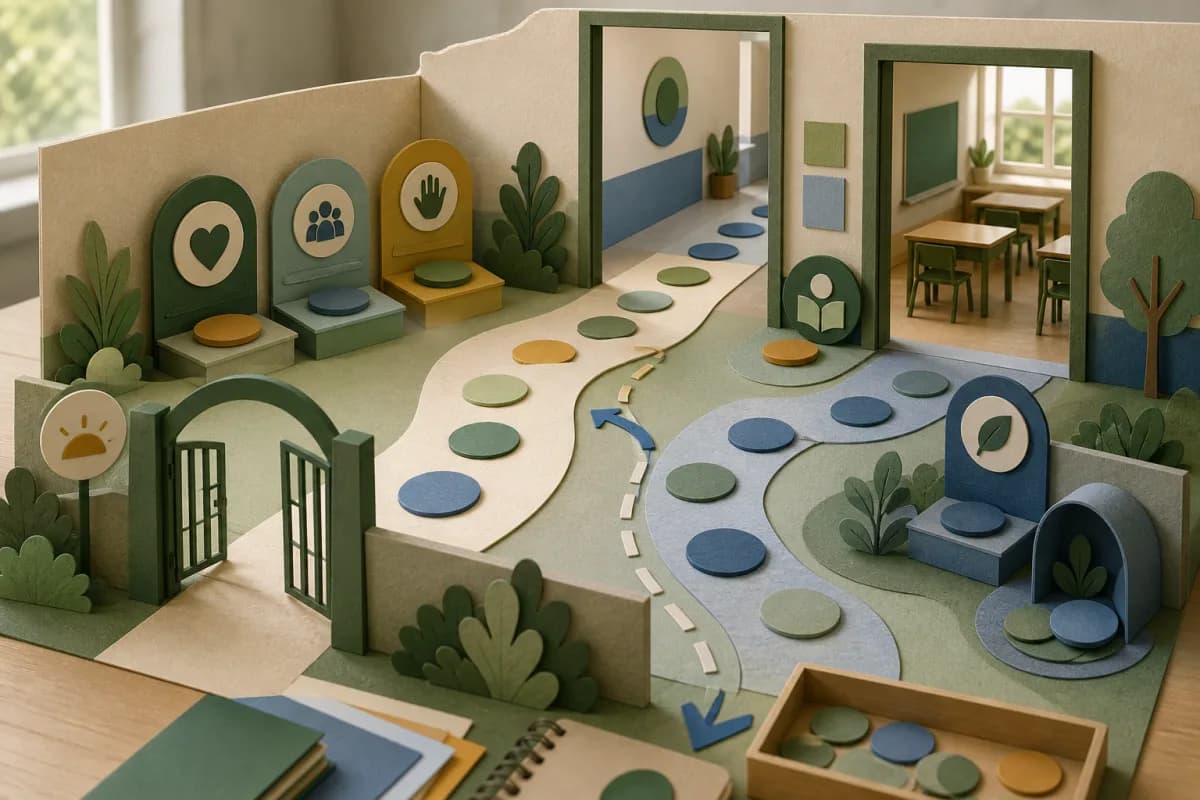
The seven-field school behaviour routines map
Keep the map short enough to use. One row should describe one routine in one setting. Avoid labels about character or intent. Record observable steps and the minimum information needed to answer the review question.
| Field | Question | Arrival example |
|---|---|---|
| Moment and place | Where and when must the routine work? | Main gate to tutor-room threshold, 8:30 to 8:45. |
| Observable sequence | What can a pupil and adult see happen? | Greet, enter by the marked route, collect prompt, meet tutor. |
| Teaching and cue | How is the routine modelled and re-taught? | Live practice, consistent adult wording and accessible visual cue. |
| Access and adjustment | What barrier might prevent participation? | Quieter entry point, extra processing time or an alternative cue. |
| Fallback | What happens when the usual route cannot work? | identified adult and calm waiting point, without an informal send-home. |
| Human owner | Who checks delivery and decides any change? | Pastoral lead, supported by the site lead, tutor, SENCo and DSL. |
| Review evidence | What will be checked, when, and what could change the view? | Walk-through, pupil and staff views, access delivery and patterns after ten days. |
Build the first map in 45 minutes
- Choose one route. Pick a routine with a clear professional question, not the largest incident total.
- Walk it at the real time. Note crowding, noise, waiting, handovers, cues, unavailable adults and places where the sequence becomes ambiguous.
- Ask how it is taught. Compare the policy, staff explanation and what a pupil can actually observe. A poster is not automatically a lesson plan.
- Seek accessible pupil views. Offer speech, symbols, drawing, AAC, a scribe or a quieter conversation. Record disagreement and uncertainty rather than converting them into compliance or non-compliance.
- Invite parent or carer knowledge where relevant and lawful. Ask what helps, what changes the situation and what the school may have missed. Do not invent agreement or treat one account as the whole explanation.
- Agree one trial. Name the professional owner, the support, the fallback and a ten-school-day review date.
Read the records together
Consider a fictional composite. Aggregated behaviour records show more incidents near one corridor during the first lesson change. The record is a signal about a place and time, not proof about any pupil's motive.
A walk-through shows two classes arriving in opposite directions while one doorway is used for a late handover. Accessible pupil feedback says the adult cue cannot be heard when the corridor fills. Class-support information shows that some pupils use visual sequencing, but the prompt is available inside the destination classroom rather than at the decision point.
The professional question changes from “Which pupils keep getting this wrong?” to “Can this sequence be understood and supported where it must be used?” The pastoral lead owns a ten-day trial of staggered release, a visible route cue and a staffed fallback. The SENCo checks agreed adjustments, teachers report whether the routine was delivered, and pupils are asked what changed.
The review may show fewer recorded incidents, better access, neither, or mixed views. None of those outcomes alone proves cause. The owner must consider delivery, missing evidence and alternative explanations before deciding whether to continue, adapt or stop the trial.

What the evidence cannot establish
A cluster by time or place cannot establish intent, diagnosis, disability, parenting, truth, future behaviour, safeguarding risk or the right sanction. A frequency count also cannot show whether the routine was taught consistently, an adjustment was available or every event was recorded in the same way.
Keep observations separate from opinion, name the source and record what is missing. Follow the ICO's data-minimisation principle: information must be adequate, relevant and limited to what the stated purpose requires. Do not copy sensitive free text into a new routines spreadsheet merely because spreadsheets have excellent appetites.
Keep safeguarding, SEND and formal exclusion decisions separate
If information may indicate abuse, neglect, exploitation, child-on-child harm, self-harm or another safeguarding concern, follow the school's current safeguarding policy and take the concern to the DSL or deputy without delay. Use the appropriate emergency or local safeguarding route where danger is urgent. A routines review must not investigate a disclosure, test whether a pupil is telling the truth or delay a referral.
On 11 August 2026, Keeping children safe in education 2025 remains in force until 31 August; the 2026 version comes into force on 1 September. Schools should prepare for the change while continuing to use the current version today.
Consider communication, sensory, health, attendance, disability and SEND context without assuming that one factor explains an event. Where the Equality Act 2010 applies, schools must consider reasonable adjustments. The SEND Code of Practice also remains relevant to planned support and review. SEND does not excuse harm to others, and a sanction does not remove the need to consider adjustments, safeguarding information, proportionality and individual circumstances.
Suspension and permanent exclusion are formal headteacher decisions under current statutory guidance for England, updated and effective from 26 July 2026. They are not routine-map fallbacks, automatic responses to a pattern or informal requests for a pupil to stay at home. For the reasonable-adjustments boundary, read the Cheam ruling guide.
The part Student Radar can support
Student Radar's Behaviour Analytics helps authorised leaders examine whole-school patterns by time, location and group, then open detail only when a defined professional question requires it. Class Overview brings relevant class context together for authorised staff before teaching or supporting a class.
The useful connection is deliberately modest: compare the mapped routine with observed delivery, behaviour patterns, pupil views and support context. An identified professional remains accountable for the question, the trial and the review.
Seven actions for the behaviour lead
- Select one arrival, movement or lesson-start routine.
- Write the observable sequence and safe fallback.
- Walk the route with the staff who use it.
- Gather accessible pupil views and relevant parent or carer knowledge.
- Check reasonable adjustments, SEND support and safeguarding routes.
- Name the owner and start one proportionate ten-school-day trial.
- Review delivery, views and patterns, including what the evidence cannot prove.
To review connected patterns without turning them into a score, explore the pastoral and behaviour workflow or request a focused Student Radar walkthrough.
Sources and further reading
- Behaviour in schools, Department for Education, updated 19 February 2024.
- Creating a school behaviour culture: audit and action planning tools, Department for Education, published 25 April 2024.
- Keeping children safe in education, Department for Education, updated 7 July 2026.
- Equality Act 2010: advice for schools, Department for Education, updated 28 June 2018.
- SEND code of practice: 0 to 25 years, Department for Education and Department of Health and Social Care, updated 12 September 2024.
- School suspensions and permanent exclusions, Department for Education, updated 26 July 2026.
- Principle (c): data minimisation, Information Commissioner's Office, accessed 11 August 2026.