
Use a whole-class hinge question in four moves: ask, commit, reveal, respond. Ask one question at a genuine decision point. Give every pupil thinking time and an accessible way to commit. Reveal responses together. Then choose a proportionate teaching response: pause and reteach, adapt support, or move on and check again.
The routine gives a teacher a quick snapshot. It does not prove why a pupil answered as they did, diagnose a need, assign a fixed group or replace later evidence. This guide is for teachers, assessment leads, SENCos and school leaders in England and is current to 15 September 2026.
Put the hinge where teaching can still turn
A hinge question belongs before the class moves from one important idea to the next. The intended learning comes first. Decide what pupils must understand, which plausible misunderstandings matter, and what you could still change in the lesson.
Department for Education early-career material describes hinge questions as quick whole-class checks at a point where the result can change whether teaching moves on, consolidates, practises or reteaches. The EEF adds an essential warning: a technique is not evidence-based in isolation. Its value depends on the learning intention, the evidence it elicits and the decision that follows.
Write the response before writing the question. If option B dominates, what will you model? If answers split, what explanation will you probe? If most pupils are secure, what will you extend and how will you support the rest? A question that cannot change teaching is merely a small survey wearing classroom clothes.
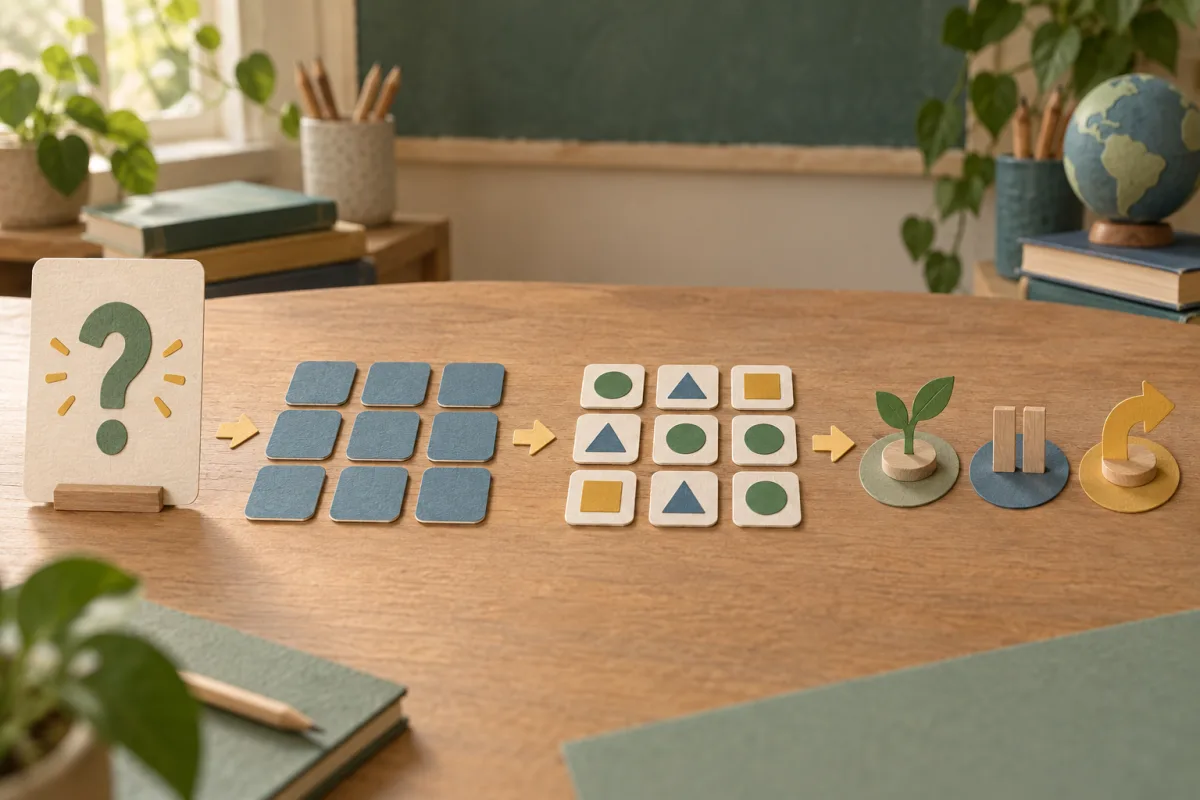
Run ask, commit, reveal, respond
- Ask. Use one question tied to the curriculum checkpoint. Its answer options should represent plausible thinking, including known misconceptions, without turning a wrong answer into a label for the pupil.
- Commit. Protect thinking time. Each pupil records or holds an answer before seeing anyone else's. Offer the usual classroom support and reasonable adjustments needed to access the intended knowledge.
- Reveal. Show responses together through mini-whiteboards, cards, a quick digital response or another accessible method. Note non-responses and uncertain answers. A tidy percentage with missing pupils hidden inside it is still missing evidence.
- Respond. Use the pattern to pause and fix, adapt support, or extend and support. Probe a sample of reasoning before acting where the same answer could arise from different thinking.
Classroom adjustments are not the same as formal access arrangements for statutory tests or regulated qualifications. Keep helpful everyday access in place, and check the current rules for the particular assessment separately. STA says the 2026 to 2027 KS2 arrangements remain unchanged, with the full assessment and reporting guidance due to be updated in October 2026.
Record enough to interpret the snapshot
Most hinge responses don't need to become permanent pupil-level data. Record the minimum that will help the teacher or subject lead review the decision: the purpose, date, curriculum point, exact task version, response conditions, support and adjustments, missing responses, teaching action, reviewer and next check.
Keep uncertainty beside the record. A response may reflect wording, copying, unfamiliar equipment, an access barrier, recent absence, incomplete curriculum exposure or a lucky guess. The response is evidence produced under particular conditions. It is not a portable fact about ability, effort or need.
Walk one synthetic example through the routine
The following Year 5 mathematics example is made up to show the decision process. The teacher wants to know whether the class is ready to compare fractions with different denominators. She asks one multiple-choice question whose distractors reflect different lines of reasoning, gives quiet thinking time and asks pupils to hold their cards face down.
On reveal, one option is common. Two pupils do not commit. The teacher asks pupils with different answers to explain their thinking, without treating them as representatives of a fixed group. The probe shows that some pupils have compared denominator size alone, while one pupil misunderstood the diagram and another missed the worked example during an authorised absence.
The class teacher models one contrast, restores the usual visual support and tries a differently worded check the next day. The mathematics lead reviews the two tasks on Friday. Pupils can explain or correct the record, and the SENCo or family can add relevant access context. The first pattern informed reteaching. It did not prove a cause, justify a referral or show that the reteaching caused any later change.

Connect the decision without creating a risk score
Connect the hinge response to the curriculum checkpoint, the teaching action and the follow-up evidence. Add attendance, support or adjustment context only when it changes the professional question and the viewer is authorised to see it. Small classes and narrow groups can be unstable and identifiable, so suppress or aggregate patterns where needed and avoid spurious precision. A pattern doesn't explain itself.
In Student Radar, Digital Markbook can keep the reviewed follow-up outcome and missing entries visible beside other class evidence. Question-Level Analysis supports topic and strand review from paper-test diagnostics. It should not be described as a live hinge-response system. Neither feature decides what a pattern means, groups pupils automatically or proves that a teaching response worked.
Review the routine with the class teacher or subject lead at the stated point. Change the judgement when a second task, pupil explanation, curriculum record, support note or missing response changes the picture. Keep a route for pupils, families and professionals to question or correct relevant records.
For the wider system, use the guide to an assessment calendar that protects teaching time. For conflicting evidence, read what to do when two assessment results disagree. To see the verified assessment workflow, request an assessment-focused walkthrough.
Sources and further reading
- Support for early career teachers: assessment and feedback theory, Department for Education, accessed 15 September 2026.
- Key stage 2 teacher assessment guidance 2027, Standards and Testing Agency, updated 14 September 2026.
- Key stage 2: assessment and reporting arrangements, Standards and Testing Agency, updated 7 July 2026.
- How checking for understanding can guide your teaching in the moment, Education Endowment Foundation, 21 January 2026.
- Checking for understanding that leads to action: adaptive teaching, Education Endowment Foundation, 23 February 2026.
- Formative assessment in mathematics, part 1: rich questioning, Dylan Wiliam, Equals, 1999; UCL Discovery record.
- Embedding Formative Assessment evaluation, Education Endowment Foundation, completed July 2018. This programme-level trial does not isolate the effect of a single hinge routine.